“If it hadn’t been for music, the civil rights movement would’ve been like a bird without wings.”
– John Lewis
On January 17, 2022, we led a workshop on “Music of the Civil Rights Movement” at Germantown Friends School to celebrate the life of Dr. Martin Luther King Jr. Music played a crucial and integral role in the Movement, serving to mobilize, encourage, and amplify the voices of those involved. Many of the defining songs of the Movement were old spirituals and traditional songs that were repurposed and adapted to reflect current events. We examined three songs in particular: “We Shall Overcome” sung by Joan Baez, “Mississippi Goddam” by Nina Simone, and “Lift Every Voice and Sing” performed by the Oakwood University choir and discussed how music can be a form of advocacy for social justice. Below is our workshop, adapted into webpage format, for you to explore.
A Brief History of Black Music
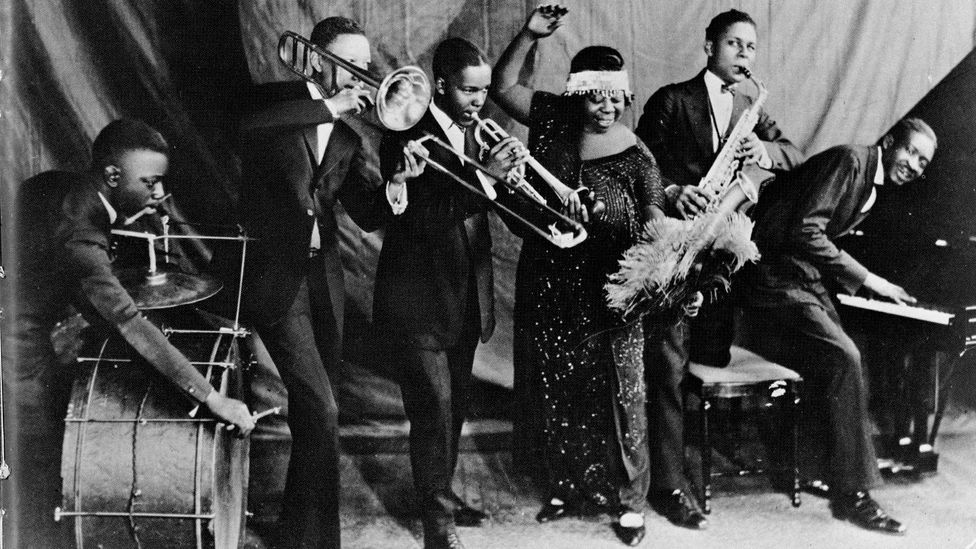
Black music in America is something that predates the founding of our nation. When enslaved people were brought to the US through the transatlantic slave trade, they brought with them traditions of communal music making. Music wasn’t solely performed as part of religious rituals, it was integral to the functioning of their communities. Over time, the music enslaved people brought to the colonies evolved and came to be many of the different forms of Black-inspired music we see today: spirituals, gospel, blues, soul, and hip-hop.
Many of the protest songs of the Movement have roots in slavery. The popular Civil Rights song “We Shall Not be Moved” was originally a jubilee spiritual called “I Shall Not Be Moved.” During the Civil Rights period, it was adapted to reflect current events. Spirituals were created during the time of slavery with the emergence of Africanized Christianity. These songs gave Blacks hope, escape, and reprieve from their lives of slavery, allowing them to express faith and sorrows.
Songs of the Movement
Song 1: We Shall Overcome
The Anthem of the Movement
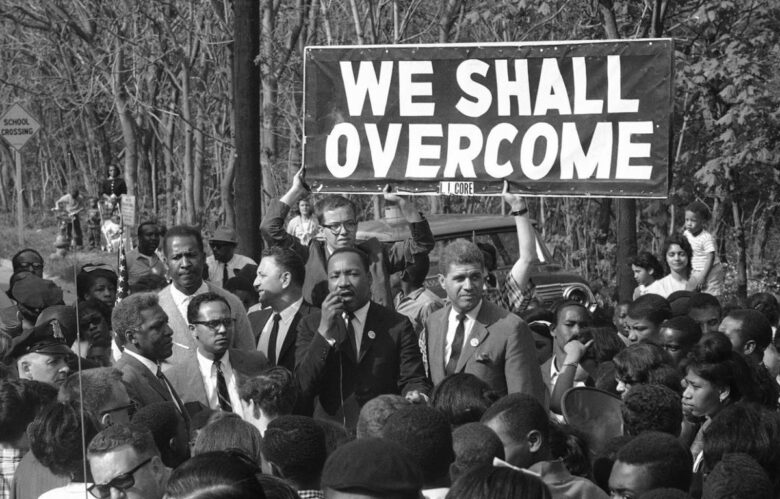
This song was known as the unofficial anthem of the Civil Rights Movement. It was the mergence of the gospel hymn “I’ll Overcome Someday” with the spiritual “I’ll Be All Right.” As time progressed, the lyrics of this song underwent many adaptations and changes to best suit its usage. In the Civil Rights Movement, the lyrics were changed from “I will overcome” to a more inclusive “we shall overcome.” The present version of the song was popularized by Pete Seeger, Joan Baez, Bob Dylan, and other folk singers of the time, who used the song at protests and rallies.
Questions to Ask Yourself:
What did you notice or observe? How do you feel after listening to the song?
Type a particular lyric that resonated with you in the chat.
“The truth will make us free”. What is meant by that lyric?
What effect does the repetition of the lyrics have on the song?
Song 2: Mississippi Goddam (Nina Simone)
Who was Nina Simone?
Nina Simone was a classical and jazz pianist, singer, and songwriter. She aspired to be a concert pianist, but was rejected from the Curtis Institute of Music, which she attributed to racism. Simone later found success in playing at jazz clubs and recorded over 40 albums during her career as a musician. She was friends/acquaintances with Lorraine Hansberry, James Baldwin, and Langston Hughes.
The Story Behind the Song
This song was Simone’s first “social justice song.” She wrote the song in response to the 16th Street Baptist Church bombing and the murder of civil rights activist, Medgar Evers. Many of Simone’s songs, including “Four Women” and “Feeling Good,” have content relevant to today’s dialogue on race and gender and the intersectionality between the two. While the former is a commentary on colorism and the archetyping of black women, the latter is a song of empowerment and freedom of expression.
Questions to Ask Yourself:
What did you notice or observe? How has your initial perception of the song changed after learning of Simone’s motivations?
Type a particular lyric that resonated with you in the chat.
Why is music such a powerful medium to affect social change?
What do you think motivated Simone to combine music and activism?
Song 3: Lift Every Voice and Sing
Some Background…
This song was adopted by the NAACP as the anthem of the movement. It was written by James and John Johnson. Originally written as a poem by James Johnson, it was adapted as a hymn by his musician brother, John Johnson. Although written in 1899, after the Emancipation Proclamation, many of the song’s themes relate to the not-so-distant past of slavery.
Let’s take a look at the lyrics…
Verse 2:
Stony the road we trod,
Bitter the chastening rod,
Felt in the days when hope unborn had died;
Yet with a steady beat,
Have not our weary feet
Come to the place for which our fathers sighed?
We have come over a way that with tears has been watered.
We have come, treading our path through the blood of the slaughtered,
Out from the gloomy past,
Till now we stand at last
Where the white gleam of our bright star is cast.
Additional Resources
Playlist of Songs of the Civil Rights Movement:
Spotify: https://open.spotify.com/playlist/2zfJWA6viYusb92podEgwq?si=c552991cd75040f5
YouTube: https://www.youtube.com/playlist?list=PLiy0URQDWg84fqAMY2GkYinbPUVCRfDR6
Songs of the Present with Themes of Social Justice:
Fight the Power – Public Enemy
Black Rage – Lauryn Hill
Alright – Kendrick Lamar
This is America – Childish Gambino
Original Slide Presentation:
https://docs.google.com/presentation/d/1dxRRBQRilvHE-RsyzUkngyNPm7L2dIuOC1a_pG6bNx8/edit?usp=sharing
FOLLOW US
CONTACT US: musiscola@gmail.com
©2023 by Musiscola
All Rights Reserved
 Musiscola